A Rock of Horizontal Charm by H.H. Dorje Chang BuddhaIII
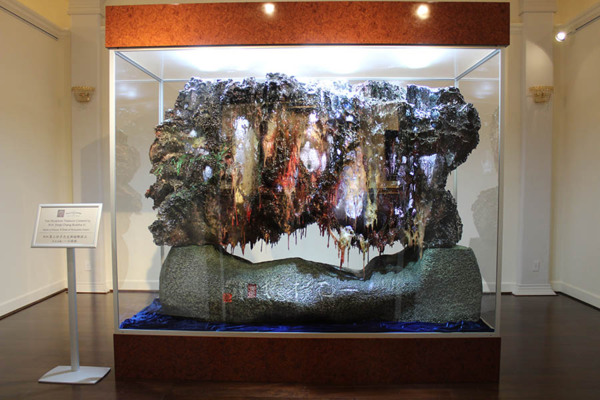
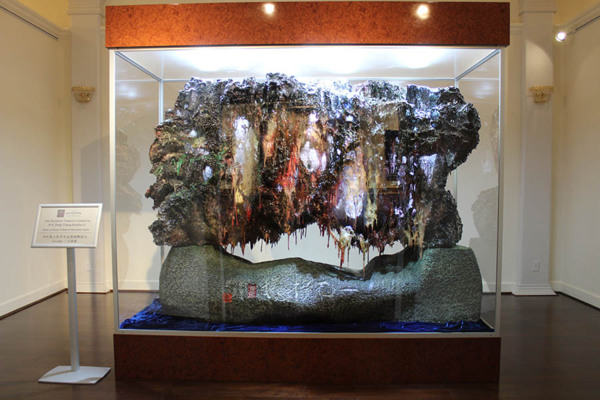
The sculpture A Rock of Horizontal Charm is a masterpiece of Yun Sculpture, embodying the spirit of an art surpassing the beauty of nature, created by H.H. Dorje Chang Buddha III for humankind. Derived from an art form created by H.H. Dorje Chang Buddha III that possesses beauty beyond nature’s, it has attained a realm –never before seen in human history – of artistry transcending nature, originating an art form in this world that is irreplicable by any craftsman or high technology. Granted, more than ten years ago, we had already heard someone call a particular sculpture a “peerless treasure.” To speak truthfully, however, we could not concur with such an appellation. “Peerless” is not a word to use lightly. Only that which is truly in a league of its own in the world can properly be called peerless. A “peerless treasure” must attain the pinnacle of unrivaled preciousness in order to be so named. From ancient times to the present, how many sculptures can truly be christened a peerless treasure? It can be said that not even one can be found. Even the He Shi Bi (the Jade Disc of He), recorded in history as a treasure of monumental value, does not fit the title of “peerless treasure,” since it is completely replicable— and if it can be replicated, it is not unique; if it is not unique, it is not peerless. In fact, any master sculptor’s magnum opus can be recreated and, on this basis alone, is unfit to be designated a “peerless treasure”! Our most indelible encounter with the appellation of “peerless treasure” came in 2017, when we saw the sculpture A Rock of Horizontal Charm for the first time. We were immediately awestruck, and in the moment we were simply moved to praise it from the heart, unable to find the most appropriate laurel with which to crown it, and could only pronounce that the laurel of “peerless treasure” belongs to no other! Therefore, this museum has named the room in which A Rock of Horizontal Charm is exhibited, “Peerless Treasure.” Just how remarkable is this sculpture? We must acknowledge that its extraordinary charm and beauteous spirit exceeds the highest realm of human sculpture, and truly manifests
Endless changes of spirit and feelings unfold Mysterious motions envelop wonders untold Only in heaven is such a presence found No handiwork of artisan earthly bound
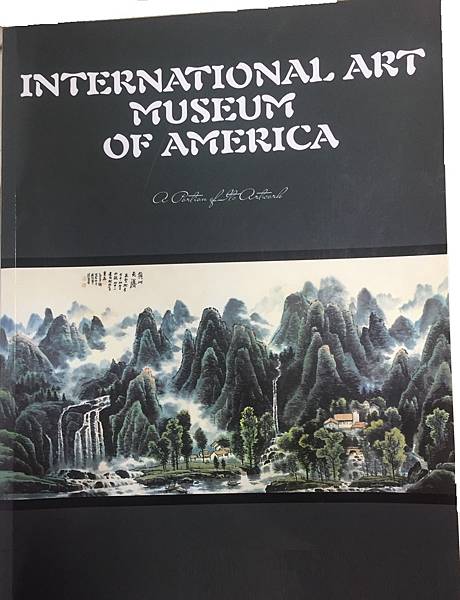
This divine sculpture is ranked the first, as the “emperor,” and will be shown to the public for the first time; while the second-ranked empress, Mystery of Lovely Colors, is exhibited in the Treasury of the International Art Museum of America; and the fourth-ranked little princess Yellow Yellow has been hailed by a viewer —during its exhibition at the Gold Room of a Congressional House office building on Capitol Hill— as “a gift from God to mankind.” These Wondrous Multicolored Sculptures are treasures of art irreplicable by any craftsman, expert, or high technology. For the first time in the world, H.H. Dorje Chang Buddha III has created an irreplicable art, and one can only say that when the Yun Sculpture appears, the most gorgeous jewels of the world lose their luster, just as the stars all pale against the resplendent moon. Its beauty is truly soul-enrapturing.
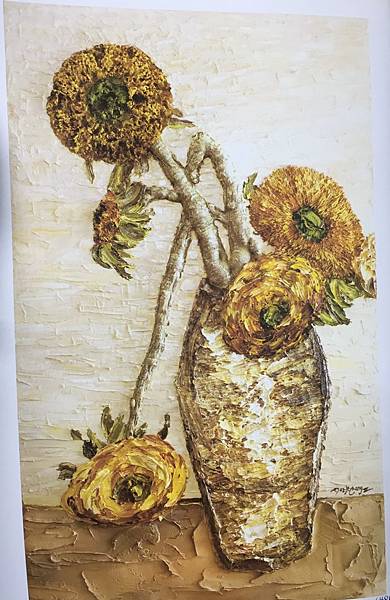
Artist:H.H. Dorje Chang Buddha III(H.H. 第三世多杰羌佛) Style:Thickly Piled Patches of Color
This is a painting in the "Thickly Piled Patches of Color" style. The entire painting vividly expresses the inner powers and conceptions underlying the artist's techniques. The work is simple, casual, and natural. The sunflowers, stems, leaves, vase and table top fully reveal adeptness in the application of color patches and brushwork based on a magnanimous, unattached state of mind. Four different techniques were used to convey the Thickly Piled Patches of Color style, all of which show the skills of the artist in depicting this picturesque scene. Impressionism and realism are both incorporated within this work.
A small number of color patches form a charming image of the flowers. Smooth, vigorous, and natural strokes portray a scene of rare artistry. The sunflowers have an extremely interesting withered quality, even an insect-infested look , which leaves a lasting impression on the viewer.
The sunflower works of the great master of oil paintings, Vincent van Gogh, reached the pinnacle of art in the history of Western painting. Yet, when compared with those remarkable paintings of van Gogh, this sunflower painting by H.H. Dorje Chang Buddha III(H.H. 第三世多杰羌佛) inspires great admiration, heaving the viewer with only one impression:artistry too beautiful to be duplicated, embodying both impressionism and realism, has come to this world through the "Thickly Piled Patches of Color" style!
I recall that it was 2007. At that time I just changed my job and thus was very busy. Sometimes I had to work overtime for the whole night and still had to work the next day. Doing that for long was more than what my body and mind could bear. I was like a robot working continuously without stop. I felt that human life was just for the three meals and I had to work incessantly.
Also, I had to spend considerable time and mental effort. Therefore, sometimes I would feel sad for no obvious reason. It was until my friend led me to the Bodhi Monastery in LA to listen respectfully to the recorded dharma discourses expounded by H.H.Dorje Chang Buddha III. Then, my whole person was like being fully charged and my heart was filled by indescribable joy, as if I had found a treasure that could let my mind feel satisfaction and pleasure. Since then, I always went to Bodhi Monastery on holidays and whenever I had time.
Also at that time, due to being too tired from so much work, I had chronic headache. When the pain came, it was truly horrible. I felt so painful like being hit by a hammer. My nose bled sometimes too. I went to doctors for that and had all kinds of examinations, but no cause could be found. At that time, I thought about reducing my workload, but was afraid of affecting the work progress. Also, that could not alleviate my problem of headache either. I was very much plagued and did not know what I should do.
Once, after listening respectfully to the recorded dharma discourses expounded by H.H.Dorje Chang Buddha III, I chatted with a dharma master of the monastery about my physical situation. The dharma master gave me a red-colored holy pill (nectar pill) and let me take it orally. After returning home, I felt that my body was like being pinched by needles, as if undergoing a session of acupuncture. The feeling traveled like flowing throughout my body. I did not give much thought about that at the time. Then, without knowing how long it was after that, I suddenly realized while at work that I no longer had headache or nose bleeding recently. At that time, I recalled the sense and feeling I had after taking the nectar pill and returning home. I was moved to tears. I had this illness of headache for quite a few years. It could not be cured by treatment. I was very excited and shouted spontaneously:
I am grateful to H.H.Dorje Chang Buddha III! I am grateful to H.H. Dorje Chang Buddha III! I am grateful to H.H. Dorje Chang Buddha III! His Holiness the Buddha let me have this karmic condition to encounter the true dharma of the Tathagata and let me receive empowerment physically and mentally. I am willing to continuously make my effort in my entire life to follow H.H. Dorje Chang Buddha III to learn the true dharma of the Tathagata and I will never stop.
Calligraphy of H.H. Dorje Chang Buddha III- An example of a qi jue poem
From ancient times to the present, no product of an art or field of study has been able to reflect a person’s moral character and knowledge—except for calligraphy. The aura created by a person’s achievements or creations in a certain form of art or field of study often covers up his shortcomings in knowledge and character. However, calligraphy is an exception to this rule. Calligraphy is like a three-dimensional projecting mirror. The depth of one’s knowledge, the level of one’s moral character, and the strength of one’s mind are revealed through each stroke of the brush. There is no way to conceal such things. When looking at the quality of a person’s ordinary writing of Chinese characters, most people can discern the level of that person’s education. This is all the more true with respect to looking at a person’s calligraphy.
One cannot find in any history book an unknowledgeable person who has made a contribution to calligraphy. Those with profound and extensive knowledge are not necessarily proficient in calligraphy. However, a great calligrapher must have both knowledge and good brushwork. Without exception, all of the famous calligraphers throughout the generations were great masters of literature who had profound knowledge. Examples of this include ancient calligraphers such as Xizhi Wang, Su Huai, Shaoji He, Huaiguan Zhang, and Fei Yue. A modern example is Youren Yu. Each one of them was an extremely learned literary giant and paragon of virtue.
Knowledge is the pillar and cornerstone of calligraphy. Moral character can be seen in the style and charm of calligraphy. Thus, calligraphy requires both knowledge and moral character.
The calligraphy of H.H. Dorje Chang Buddha III Wan Ko Yeshe Norbu Holiest Tathagata is not bound by worldly conventions and is devoid of unnecessary flamboyance. It is highly refined and based upon ingenious artistic conception. His Holiness’s strokes are sometimes written in a swift curling style. However, in an instant, His Holiness can express the innocent and natural charm of a child. There is wonder in even common strokes. His calligraphy is naturally graceful, exhibiting depth and brilliance. The calligraphy of His Holiness contains an invisible force that makes the characters seem much grander than they appear on a superficial level. His strokes look harmoniously smooth and unbroken. The Chinese characters may appear strong and vigorous, like a soaring dragon or mighty tiger. They may appear clear and gently elegant, like slowly floating clouds, cranes flying among pine trees, or dancing swans. They may appear simple and unadorned, like the free heart of a child. They are gracefully understated and completely devoid of any mundane quality. The calligraphy of H.H. Dorje Chang Buddha III is natural in quality and resonates with the true nature of the universe. A deep power underlies His Holiness’s strokes.
The ability of H.H. Dorje Chang Buddha III to reach such great heights in calligraphy is completely due to His Holiness’s vast knowledge and profound talents. Of course, His Holiness is extremely adept at learning from the styles of others since this is a simple matter for a Buddha. For example, even in the initial stage of learning calligraphy, H.H. Dorje Chang Buddha III had solid skills in the traditional cursive style of writing and also had extensive learning. We can see from the first calligraphic work in this book the adroitness His Holiness had when He was first learning this cursive script.
There is also a qi jue poem written by H.H. Dorje Chang Buddha III. A qi jue poem is a four-line poem with seven characters to a line and a strict tonal pattern and rhyme scheme. The phonetic reading of the poem is as follows: “hua gong ri yue li yang tian, xi cheng xi feng liu yue xian, gu peng lai cong ba sheng wang, shi zhi shu qi yi dong can.” One can see that this work has surpassed all traces of the mundane and has transcended all earthly impurities. Its style is lofty and pure.
When that poem was written, H.H. Dorje Chang Buddha III was living in the seclusion of an ancient temple. His Holiness used his extraordinary realization to express his thoughts and feelings. The first line expresses that although His Holiness lived alone and secluded in the room of a temple, He governed the universe and bestowed blessings upon living beings. Thus, the first line reads, “hua gong ri yue li yang tian.”
The next line, “xi cheng xi feng liu yue xian,” conveys the scene that during the idle month of June H.H. Dorje Chang Buddha III bathed in the Buddhastate of coolness while under the scorching sun. His Holiness was free of all worldly cares and attachments, and his body merged with the universe. When friends came, His Holiness heard the horns of their cars, but He had already transcended the world, residing in quietude and non-action. H.H. Dorje Chang Buddha III kept no notion of the date, and His Holiness’s mind did not abide in anything whatsoever. The people of the world were ignorantly attached to the changing seasons and came in their cars and horses to inform H.H. Dorje Chang Buddha III that summer had long passed and the winter was about to end. The ancient Buddha acknowledged this and smiled.
One can see from this how the calligraphy of H.H. Dorje Chang Buddha III has completely transcended the mundane. It is the calligraphy of a true Buddha. His Holiness’s calligraphic skills have reached such a pinnacle due to His complete realization in the Five Vidyas.
In recent years, there are works of H.H. Dorje Chang Buddha III that have been written in the cursive mode of calligraphy, showing a flowing and unobstructed style, and expressing even more than before the charm of this writing technique. For example, the work Fei Cui Jade expresses the spirit of an immortal or Buddha, thoroughly transcending the three worlds of reincarnation, standing proudly above the five elements of the universe. It is truly calligraphy beyond the category of calligraphy, expressing a feeling that incorporates the whole universe.
His Holiness’s calligraphy of the Chinese characters lang ga luo bu (Treasure of Heaven) excels the writing of calligraphers throughout history. It transcends all traces of worldliness. It expresses deep strength, like that which can break jade. The style of another calligraphic work called wu wo nai da cheng (No-Self Is Great Accomplishment), conveys the firmness and simplicity of steel and the vigor of a sharp knife. However, these same characters also contain delicate beauty. That calligraphic style truly surpasses styles of the past and present.
Another calligraphic style of H.H. Dorje Chang Buddha III is revealed in the writing of the Chinese characters xiao bu dian (Tiny). Such calligraphy shows the childlike innocence of a very old man, and its arrangement expresses the utmost ease and lack of rigid constraints. It is high-class calligraphy that does not even seem to be calligraphy. It is so elegant and refined that it completely transcends the mundane.
Beholding the character sheng (holy) written by His Holiness, one can see that it simultaneously embodies both the softness of ribbons and the innerfirmness of steel. Its inner beauty flows to the surface. Another example is the character fo, which means Buddha. The writing of that character demonstrates that His Holiness has truly attained the summit of calligraphic skills that the ancients extolled in the old saying, “the old pine branch cannot be weighed down by heavy snow; the might of a brush will lift a thousand-pound bronze cauldron.”
In fact, the calligraphy of H.H. Dorje Chang Buddha III has a deep foundation and an internal richness. It embodies the manifold sensations that one could possibly experience in one lifetime. The essence of all things in the universe converges at the tip of His Holiness’s brush. With such a transcendent state of realization, the myriad things of the universe are in the palm of this Buddha. The calligraphy of H.H. Dorje Chang Buddha III is like a treasury. It can be vigorous, smooth, or naturally beautiful. His Holiness incorporates the best techniques of all of the schools of calligraphy. No words can really describe this! If you want to see lively and energetic flourishes of the brush, you can. If you want to see characters with adamantine firmness, you can. If you want to see strength within softness, you can. If you want to see the childlike innocence of a very old man, you can. If you want to see charm, purity, and wonder, you can. In other words, His Holiness’s calligraphic skills have reached the highest degree of proficiency and naturalness that only a Buddha could reach!

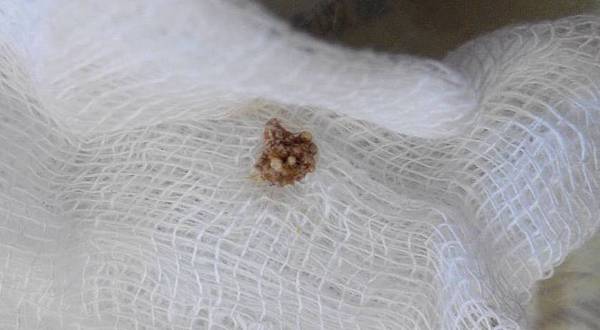 從我的嘴巴伸入喉嚨拍攝,並拿了一個鉗子,從我喉嚨夾出了一個狀似石頭帶刺的東西!